Careers & Business
Career change without erasing experience
A reflective, practical guide to changing careers after displacement while carrying forward skills, context, and dignity.

A career change can make earlier experience look invisible, especially when a move has changed language, industry, or access to familiar networks. The first useful act is to resist the blank-page story. Previous work contains habits, responsibilities, and ways of solving problems that can be translated into a new setting.
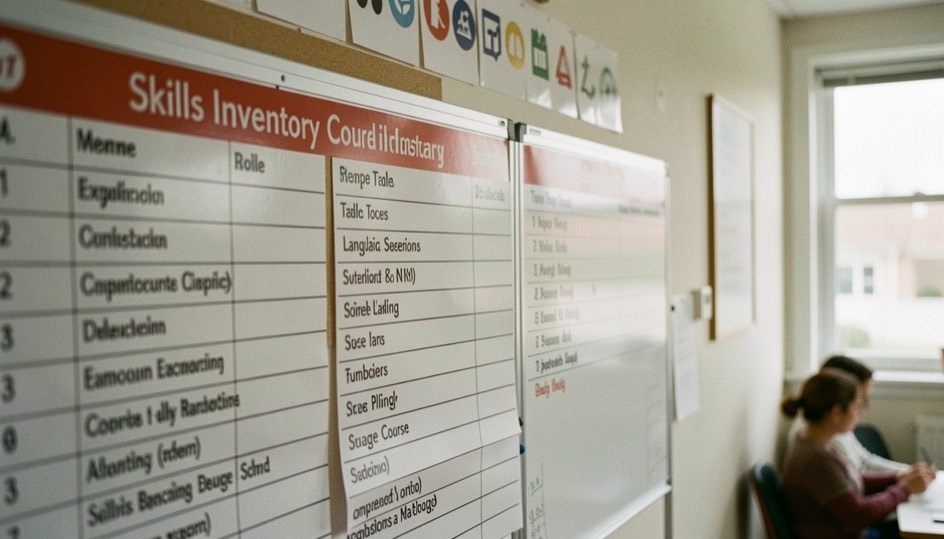
Build a skills record
Write down the situations you handled rather than only the titles you held. A person who organized a team, cared for a client, repaired a process, or explained a difficult idea has evidence that can travel across sectors. Keep the original context beside the new wording so the translation stays honest.
Choose a small bridge
Instead of trying to become a completely new professional at once, find one activity that connects old knowledge to the next field. It could be a short project, a volunteer contribution, a course exercise, or a conversation with someone doing adjacent work.
- List tasks, decisions, and conditions, not just job names.
- Keep examples that show care, reliability, and learning.
- Ask for feedback on one translation at a time.
- Let the new direction develop through evidence.
Continuity is not a demand to stay the same. It is a way to enter change with more of yourself available.
Map experience at the level of responsibility
Start with a table of situations rather than job titles. For each role, note who relied on you, what you decided, what tools or materials you handled, which problems returned, and how you knew the work was complete. Include paid work, family enterprise, community activity, independent projects, and periods of informal responsibility when they demonstrate relevant practice.
Then group the evidence into capabilities such as organising work, maintaining quality, explaining technical information, caring for customers, managing records, or coordinating people. Keep the original context in your private notes. The public CV can be concise, but you should still be able to explain where every claim came from.
Choose a bridge role, not an imaginary restart
A bridge role shares at least one responsibility with your previous work and one with the direction you want to enter. A teacher moving toward instructional design may begin with learning materials. A technician moving toward operations may focus on maintenance records and incident response. A shop manager entering digital commerce may build on inventory, suppliers, and customer communication. This makes the transition easier to demonstrate and easier for another person to understand.
List the true gaps separately. Language, local regulation, software, credentials, and professional networks require different solutions. A course may address a tool; an assessment may clarify a credential; a supervised project may provide local evidence. Treating every gap as a need for another degree can waste time and hide strengths already present.
Create fresh evidence in small units
Choose one project that can be completed and reviewed within a few weeks. Write a process guide, analyse a public dataset, repair a community workflow, translate a technical explanation, or contribute to a documented open project. Define the audience and output before starting. Ask for feedback tied to the work, then keep the revised artifact and the date of the review.
- Keep one master skills record in the language most useful to you.
- Create tailored summaries for different roles instead of rewriting history.
- Ask references to describe responsibilities and conditions, not only titles.
- Prepare a short explanation of gaps without apologising for them.
- Track applications and conversations to see which evidence creates interest.
Tell a continuity story in interviews
Use a three-part answer: what you were responsible for, what changed around you, and what bridge you built toward the new work. Avoid presenting displacement as a motivational slogan or as the only fact about your career. The interviewer needs enough context to understand the transition, then concrete evidence of how you operate now. A good story preserves dignity because it connects change to decisions and work rather than asking hardship to stand in for skill.
Keep the context, make the decision visible, and leave a useful next step.

Continue the thread
Read the career transitions topic, open the working abroad dossier, or meet the editorial desk.